
When it comes to studying or teaching abroad, the support systems that serve Australians best are pre-departure guidance, financial assistance, hands-on training, and regular mid-program check-ins. And most people only discover how important these are once they’re already overseas.
That’s because most people treat support as an afterthought. They research destinations, universities, and teaching jobs in detail, but give little thought to what backing they’ll have once they arrive. And by the time that oversight shows up, the situation has already gotten hard to manage.
That’s exactly what this article is for. It covers OS Help loans, TEFL training, cultural prep, and crisis contacts, so you’re not figuring it all out on the fly.
Let’s get into it.
Pre-Departure Support: Visas, Credits, and Getting Ready to Go
As we mentioned earlier, people don’t think about support until it’s too late. Proper study abroad support, when you seek it out early, kicks in well before you board the plane.
In practice, that means your provider is already working with you weeks before you leave. They cover visa guidance, housing, and on-the-ground preparation, so that when you land, you have everything ready.
Two areas stand out as the most practical places to start.
- Pre-departure Visa Guidance: Australian providers walk students through visa requirements, application timelines, and required documentation for their destination country. Beware that getting this stage wrong can delay your entire program by weeks.
- Australian University Credit Transfers: Many Australian university partnerships include formal credit transfer agreements, meaning the units you complete overseas count directly toward your degree back home. That saves you time and money.
Once you’ve got the pre-departure groundwork sorted, the next thing worth understanding is how the Australian government helps fund your overseas study. For a full overview of student support services, StudyAustralia is a solid starting point.
OS Help and Government Loans for Overseas Study

Funding an overseas semester is a common hurdle for Australian students. OS Help (Overseas Study Help) loans exist specifically for this reason, and yet a lot of students don’t even know about them until someone points them out.
So here’s how it works. The Australian government offers OS Help loans to eligible students studying overseas as part of their enrolled Australian degree. In short, the loan pays your tuition fees at the overseas institution, so you don’t have to.
Also, depending on your enrolment situation, Fee Help (a government loan for tuition fees) and HECS Help (Higher Education Contribution Scheme) may apply, and each works slightly differently.
Remember to always confirm your citizenship and residency requirements with your provider before applying, as eligibility varies depending on your course and qualification. For full details, visit StudyAssist.
Finances aside, the question most Australians underestimate before heading overseas is whether they’re genuinely ready to teach once they get there.
The Training and Teaching Skills You Need Before Going Overseas
Honestly, walking into a classroom in Thailand or China without proper preparation is a jarring experience. The language barrier alone changes how you deliver lessons, manage behaviour, and assess student understanding. The teachers who struggle most are usually the ones who assumed enthusiasm was enough preparation.
Getting that preparation right comes down to two areas:
Classroom Skills That Travel Well
Good teaching skills don’t develop overnight, which is why structured pre-departure training makes such a difference. So, providers who invest in this kind of training cover classroom management, lesson planning, and student assessment.
For the professional standards teachers need before heading overseas, the Australian Institute for Teaching and School Leadership (AITSL) is worth checking before you apply.
Adapting to a New Country and Culture
Classroom skills will only get you so far. Understanding local customs, communication styles, and classroom expectations in your destination country before you arrive is just as important. And teachers who do this connect with students far more effectively.
Skills and cultural awareness will take you a long way. But without the right certification, you’re essentially showing up to a job interview without a resume.
TEFL Certification for Teaching Abroad
TEFL (Teaching English as a Foreign Language) certification is the standard qualification for teaching English in a foreign language classroom. Schools overseas won’t look at your application without it, and that’s not an exaggeration. So the sooner you get certified, the better position you’re in.
Here’s a quick breakdown:
|
Online TEFL |
In-Person TEFL | |
|
Duration |
4–6 weeks |
3–6 months |
|
$275–$425 |
$415–$600 | |
|
Flexibility |
Study at your own pace |
Fixed schedule |
|
Best for |
Working adults |
Full-time students |
TEFL courses cover practical teaching skills like lesson planning, classroom management, and how to teach grammar to non-native English speakers. That breadth of preparation is what sets certified teachers apart.
Once you have your TEFL certification sorted, the focus shifts to what happens after you arrive, and how to make sure support doesn’t dry up mid-program.
How Students Get Support While They’re Overseas

Most support gaps don’t show up on day one. It’s around the three-month mark that homesickness, workload, and culture shock pile up. And that’s when having the right support structure counts.
Thankfully, students with access to academic assistance, regular provider check-ins, and personal well-being resources are significantly better placed to push through that period.
That support typically covers three areas.
- Academic Support Access: International students need access to tutors, language assistance, and study resources to keep up with coursework abroad. Without these, falling behind mid-program is a common outcome.
- Personal Well-being Check-ins: A good provider doesn’t just check in on day one and disappear. The truth is, regular touchpoints throughout the program mean problems get caught before they spiral.
- Mid-program Challenge Management: Culture shock, language barriers, and loneliness are common for overseas students. Good programs address this directly through peer support networks, cultural orientation sessions, and access to counselling services.
Students who don’t get mid-program support are significantly more likely to come home early. The Australian Government’s resource for international students studying overseas is a good place to check what you’re entitled to before you enrol.
Regular support helps you stay on track, but emergencies overseas require a different kind of preparation altogether.
What to Do When Things Go Wrong Abroad
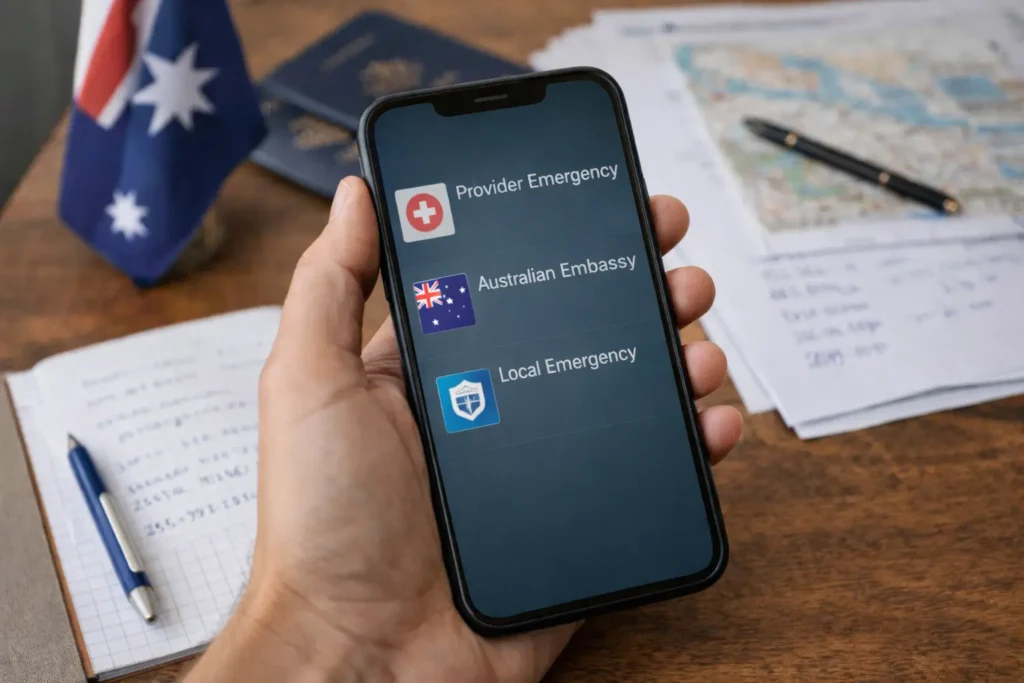
When something goes wrong overseas, knowing your support options ahead of time saves a lot of stress. And honestly, most providers bury their emergency procedures in a welcome pack nobody reads, so don’t let that be you.
Before you go, make sure you have these three things covered.
Emergency Contact Preparation
Before leaving Australia, save three contacts on your phone: your provider’s 24-hour emergency number, your nearest Australian embassy, and the local equivalent of 000 for your destination country. We suggest you keep a written copy of these somewhere safe as well.
On top of that, the Australian government’s Smartraveller website lets you register your travel plans so someone official knows where you are if things go seriously wrong.
Provider Crisis Processes
Don’t sign with a provider until you’ve asked three things: how they handle medical emergencies, what their plan is if your program gets cancelled, and whether they have someone on the ground in your destination country.
Keep in mind, a provider who can’t answer these clearly isn’t worth your time.
Built-in Program Support
The best overseas programs include a dedicated crisis response plan as part of their course structure, covering emergency accommodation, medical referrals, and direct contact with Australian support services. If your program doesn’t offer this, it’s worth asking why before you commit.
For official contacts and teaching resources for Australians overseas, the Queensland Government is a useful reference point. With all of that covered, the last step is pulling it all together before you go.
Support Is There When You Need It
Good support doesn’t find you. You have to go looking for it, and knowing exactly what to ask and where to look makes that process a lot more straightforward.
This is why we always tell our clients that before committing to any provider, research them thoroughly. Make sure you ask specific questions about what support they offer, and pay close attention to the answers. The providers worth trusting are the ones who answer those questions without hesitation.
From there, it’s about having the right resources in your corner. Sites like Highlands Golfcourse can help point you in the right direction when you’re weighing up your options.
The support is out there. You just have to ask for it.