
You’ve probably looked at rankings, top universities, and global league tables, but still feel unsure about where you want to study abroad. That uncertainty usually appears when the decision moves beyond admissions and into what life would actually look like in a new country.
The problem is that most “top countries” lists focus heavily on academic reputation, while ignoring how it feels to be a student there. That includes cost of living, cultural comfort, visa rules, and lifestyle. And those factors often determine whether your time abroad feels manageable or overwhelming.
In this guide, we’ll break down the best countries to study abroad based on lifestyle factors such as affordability, student experience, and cultural fit.
By the end, you’ll have a clearer idea of which destinations actually match the way you want to live.
What Rankings Miss About Studying Abroad
What rankings miss is everything that determines whether studying abroad is actually workable in real life. They rarely reflect affordability, so tuition gaps, rent, food costs, and hidden expenses often go unaccounted for. They also ignore visa complexity and post-study work rules, which can completely change whether a destination is viable.
Beyond logistics, rankings say little about cultural adjustment, language barriers, or how welcoming a place feels for international students. Even day-to-day factors like part-time job access, campus support, and housing availability are largely absent from these lists.
What rankings capture reasonably well is academic reputation. They tend to reflect research output, faculty credentials, and institutional prestige, especially among long-established universities with strong global visibility.
But for most students planning to study abroad, those measurable academic signals are only one part of a much larger equation.
Cost of Living: The Number That Defines Your Daily Life
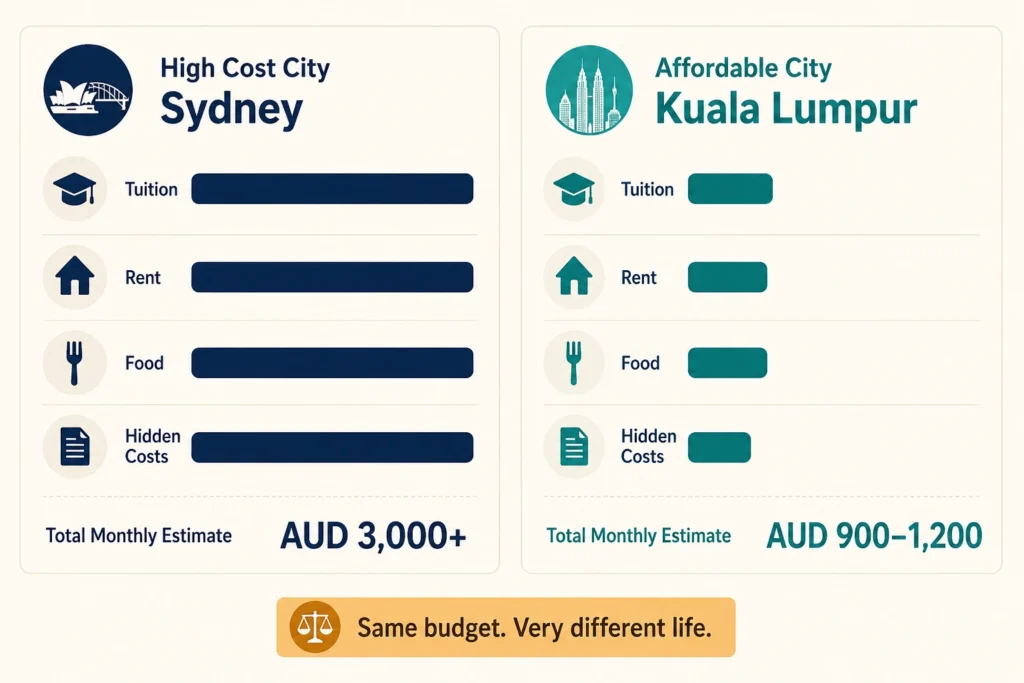
Most students focus on tuition fees when researching study destinations, and that’s fair enough. But tuition is rarely the expense that catches people off guard. Living costs are. Here’s what the total cost of studying overseas typically breaks down into:
- Tuition Fees: These vary widely depending on the country and programme. In Australia, international students typically pay between AUD 20,000 and AUD 45,000 per year. Germany and Norway, on the other hand, offer world-class education at public universities with no tuition fees at all.
- Living Expenses: A student renting in Sydney or Melbourne can easily spend AUD 2,500 to AUD 3,000 a month before factoring in food and transport. The same budget stretches much further in cities like Busan in South Korea or Kuala Lumpur in Malaysia.
- Scholarships and Funding: Scholarships can reduce tuition costs, but many only cover part of the total expense. So before relying on one, check whether it includes housing, health insurance, travel, and other living costs.
- Hidden Costs: Visa application fees, health cover, and course materials are easy to overlook when comparing destinations. These expenses can add hundreds or even thousands of dollars to your overall budget if they’re not accounted for early.
We suggest mapping out all four categories before making a decision. Students who do this consistently tell us that knowing the full cost upfront helps reduce financial stress and avoid surprises later.
Student Visas and Work Rights: The Basics You Cannot Afford to Skip
Student visa requirements vary widely across countries. And most require proof that you can support yourself financially, maintain health insurance, and meet specific enrolment and documentation requirements.
Post-study work rights are just as worth researching. They determine how long you can stay and work in your host country after graduation. Australia, for instance, allows international graduates to live and work for two to three years after completing their degree, depending on the qualification level.
And if building a career in your study destination is part of the plan, work rights and visa pathways should sit near the top of your checklist. Some countries also offer very limited post-graduation work options, so finding that out late can leave you scrambling to change your plans.
Does the Country Suit the Way You Live?

The honest answer is: it depends on you. A country that works brilliantly for one student can feel isolating and exhausting for another. The difference often comes down to lifestyle factors like:
- Language: Say you’ve spent your whole life in Australia and you’re now moving to South Korea. Simple daily tasks like grocery runs and making friends outside campus all happen in a language you don’t speak yet. That shift can feel like an adventure or a daily grind, depending on you.
- Culture and Social Norms: Every new country has its own unwritten rules. South Korea, for instance, has a very different social culture from Australia. By contrast, parts of the Middle East have specific expectations around dress and behaviour that are worth understanding before you arrive.
- Campus Life and Support Services: University life looks different depending on where you study. Some campuses are vibrant communities with strong support services for international students. Others have a more laid-back culture that suits independent students who prefer to find their own footing.
- English-speaking Environments: Moving to a country where English is widely spoken removes one major adjustment from the equation. Even then, it can take time to get comfortable with local accents, slang, and cultural references.
We’ve worked with students who crossed South Korea off their list immediately because of the language barrier, then changed their mind after spending 20 minutes in an expat forum. That conversation told them more about daily life than any university ranking ever could.
Not Every Academic System Is Built for Every Learner
If you’re planning to study abroad and haven’t looked into how your destination teaches, that’s worth doing before anything else. It’s because each country structures its academic programmes differently.
Take the UK, for instance. It tends to favour independent research and self-directed study, with less frequent contact hours than most students from Australian high schools expect. Germany, by contrast, leans toward structured, technical learning that works well in STEM fields but can feel rigid if you prefer flexibility.
Faculty access is another factor worth checking. Some education systems offer small group tutorials and regular one-on-one time with lecturers. Others put you in a lecture hall with hundreds of students and expect you to drive your own learning outside of classes.
Those details, more than any ranking, tell you whether a university’s day-to-day reality actually matches the way you learn.
What to Check Before You Commit to a Destination
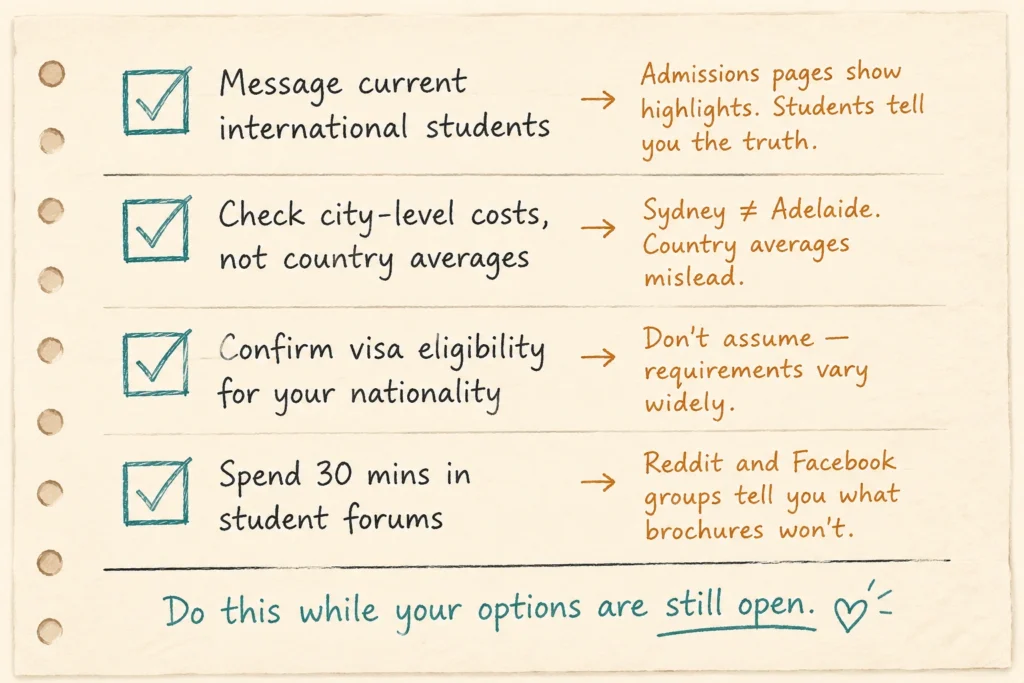
Most students finalise their destination based on what a university’s admissions page tells them. Those pages are designed to impress. The honest picture of daily life lives elsewhere, and these four checks will get you there.
| What to Check | Why It’s Worth Doing |
| Message 2-3 current international students | Admissions pages show the highlights. Current students tell you what the first three months actually feel like. |
| Look up city-level living costs, not country averages | A student in Sydney pays significantly more than one in Adelaide. Country averages will give you a false sense of security. |
| Confirm visa and scholarship eligibility for your nationality | Requirements vary by nationality, programme type, and study period. Don’t assume you qualify until you’ve checked. |
| Spend 30 minutes in student and expat forums | Communities on Reddit and Facebook groups give you unfiltered accounts of daily life that no brochure will. |
We’ve had students come to us after committing to a destination, only to discover the city-level costs blew their budget completely. Every one of them said the same thing: they wished they’d done this research first. So run through this list now, while your options are still wide open.
Your Dream Destination Starts With the Right Questions
Most students pick a study destination the same way they pick a university on a ranking list: they look at the top of the table and work down. That approach leaves out everything that determines whether you’ll actually enjoy your time abroad.
With that in mind, you now have a better framework than most applicants ever use. The next step is to run your shortlist through it honestly and see which destination actually fits.
When you’re ready to take the next step, Highlands Golfcourse has the resources to help you move from shortlist to decision.